
 +92 332 9072922


Historical Forts of Pakistan: A Journey Back in Time Through the Country’s Majestic Heritage
Pakistan is home to some of the most remarkable fortresses in South Asia—architectural monuments that reveal centuries of conquests, dynasties, trade routes, and cultural evolution. These historical forts of Pakistan are not only engineering marvels but also powerful visual narratives of the civilizations that shaped this land. Whether built by Mughal emperors, Sikh generals, ancient tribes, or regional rulers, each fort has a captivating story waiting to be discovered.
From the deserts of Cholistan to the mountains of Gilgit-Baltistan, here is a comprehensive exploration of Pakistan’s most iconic forts, enriched with historical background and travel insights.
Stepping into a time machine-visiting ancient places
It’s like travelling back in time when you visit a historical site. It’s entertaining to see and handle artefacts from the past. Places with a rich history are like large books. You can discover more about the past and its inhabitants by investigating them. It’s similar to embarking on an adventure or solving a riddle, bringing a thrill to the experience. Whether exploring local culture or tracing historical sites, even planning a flight to Pakistan adds excitement, turning history into something real and enjoyable.
1. Lahore Fort – The Mughal Crown Jewel
Location: Lahore, Punjab
Era: Originally 11th century, expanded heavily during the Mughal Empire
UNESCO World Heritage Site
Lahore Fort (Shahi Qila) represents the peak of Mughal architectural sophistication. While earlier structures existed, it was Emperor Akbar who rebuilt the fort with red sandstone in the 16th century. Emperor Shah Jahan later transformed it with white marble chambers, richly decorated pavilions, and mesmerizing frescoes. Key attractions include:
-
Sheesh Mahal (Palace of Mirrors)
-
Naulakha Pavilion
-
Alamgiri Gate built by Aurangzeb
The fort’s history mirrors the rise, grandeur, and decline of the Mughal Empire, making it one of the most significant historical sites in Pakistan.
2. Rohtas Fort – The Unconquered Military Masterpiece
Location: Jhelum, Punjab
Era: 1541, built by Sher Shah Suri
UNESCO World Heritage Site
Rohtas Fort was constructed as a strategic base to suppress local tribes and block Emperor Humayun’s return. Known for its colossal walls, towering gateways, and unparalleled military architecture, Rohtas never fell to an invading army. Its massive Haathi Gate (Elephant Gate) and intricately designed Sohail Gate illustrate advanced defensive design.
Rohtas highlights the genius of medieval South Asian warfare architecture.
3. Derawar Fort – The Desert Giant of Cholistan
Location: Bahawalpur District, Punjab
Era: Originally built by Rai Jajja Bhatti; rebuilt in 18th century by Nawab Sadeq Muhammad Khan I of Bahawalpur**
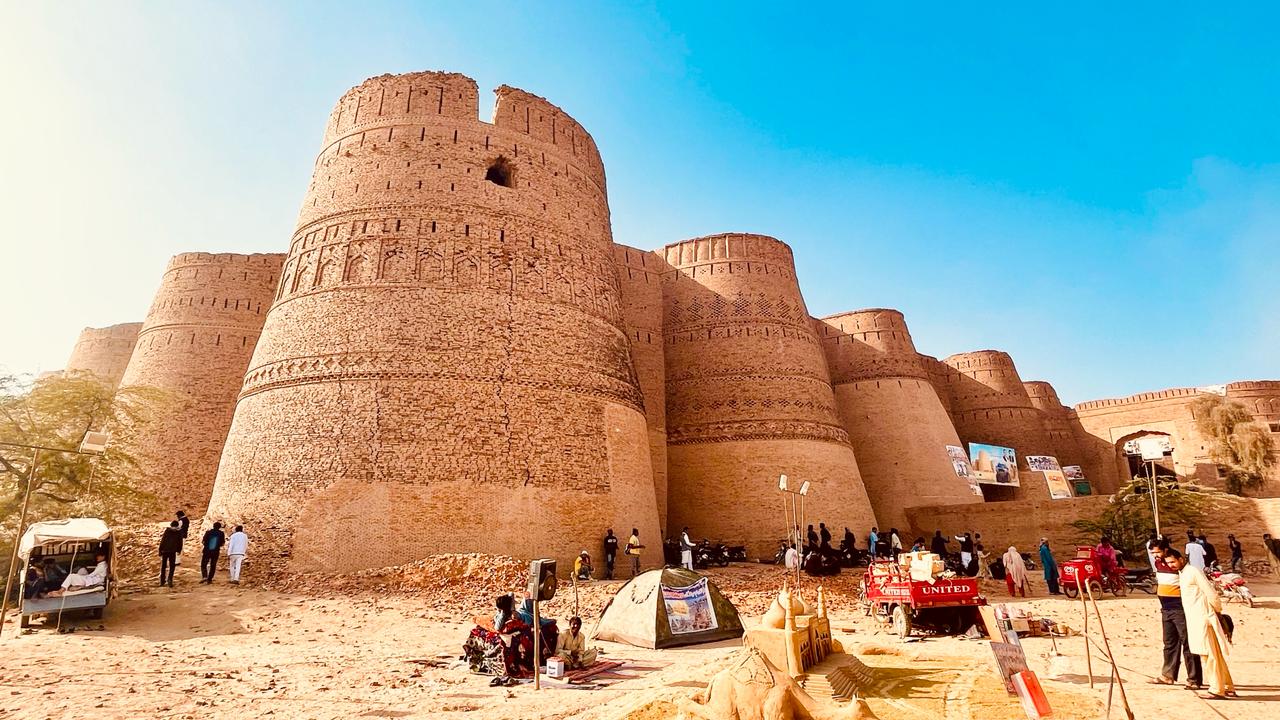
Derawar Fort, with its 40 towering bastions, dominates the barren landscape of Cholistan Desert. Serving as a stronghold of the Abbasi rulers of Bahawalpur, the fort protected caravans and controlled desert trade routes. Its thick walls and geometric symmetry make it one of the most visually striking historical structures in Pakistan.
4. Ranikot Fort – The Great Wall of Sindh
Location: Jamshoro District, Sindh
Era: Likely revived during the Talpur dynasty (18th century)**
Often referred to as the largest fort in the world, Ranikot spans 32 kilometers. The exact origins of the fort remain a mystery, adding a layer of intrigue. With rolling walls stretching over hills and dramatic landscapes, it resembles a natural-stone version of the Great Wall of China.
5. Baltit Fort – The Tibetan Legacy of Hunza
Location: Karimabad, Hunza
Era: 8th century (reconstructed over time)**
Baltit Fort reflects Tibetan influence, brought to Hunza through ancient trade and political relations. Served for centuries as the residence of the Mirs of Hunza, the fort stands as a testament to mountain craftsmanship: carved wooden balconies, stone foundations, and defensive watchtowers. Today it is a museum showcasing over 700 years of Hunza’s royal history.
6. Altit Fort – More Than 1,000 Years of History
Location: Altit, Hunza
Era: Over 1,100 years old**
The ancient capital of Hunza, Altit Fort was built primarily as a defensive stronghold overlooking the valley. It is believed to have been constructed by Tibetan artisans. The fort’s strategic location, stone architecture, and restored regal chambers highlight the evolution of mountain fortification.
7. Kot Diji Fort – The Talpur Defense Wall
Location: Khairpur, Sindh
Era: 1790s, by Mir Sohrab Khan Talpur**
Perched above the archaeological site of pre-Harappan Kot Diji civilization, this fort was designed to prevent Sikhs from invading Sindh. Its three-tiered walls, sharp angles, and fortified ramparts demonstrate advanced Sindhi military engineering. The fort served as a regional command post before British annexation.
8. Attock Fort – Guarding the Gate of Empires
Location: Attock, Punjab
Era: 1581, by Emperor Akbar**
Strategically located at the confluence of the Indus and Kabul Rivers, Attock Fort controlled movement between Central Asia and the subcontinent. It was a key checkpoint for armies, caravans, and traders for nearly four centuries. The fort later served under Sikh and British control due to its prime military position.
9. Bala Hissar Fort – The Watchtower of Peshawar
Location: Peshawar, Khyber Pakhtunkhwa
Era: Ancient origins; rebuilt by Mughal emperors and Durrani rulers**
Overlooking Peshawar city, Bala Hissar served as a royal residence and military headquarters for multiple empires, including the Durranis, Mughals, Sikhs, and British. The fort symbolizes the turbulent history of the frontier region.
10. Shigar Fort – The Palace on the Rock
Location: Shigar, Skardu**
Era: 17th century, built by the Amacha Dynasty**
Restored by Aga Khan Cultural Services, Shigar Fort blends Tibetan, Kashmiri, and Balti architectural elements. Today it functions as a heritage hotel and museum, offering an immersive experience into Balti royal culture.
11. Khaplu Fort – The Palace of the Yabgo Kings
Location: Khaplu, Baltistan**
Era: 19th century**
Khaplu Fort’s wooden architecture, carved balconies, and mountain landscape make it one of the most beautiful palaces in Pakistan. It served as the seat of the Yabgo dynasty, who ruled the region for centuries.
12. Rawat Fort – Ghakkar and Mughal Footprints
Location: Near Islamabad
Era: 16th century**
Rawat Fort was built to guard the historic Grand Trunk Road. It served both as a caravanserai and a defensive site during clashes between Ghakkars and Afghan forces.
13. Pharwala Fort – The Lost Kingdom of Ghakkars
Location: Near Islamabad
Era: 15th century**
Only accessible to Pakistani visitors, Pharwala Fort was once the headquarters of the Ghakkar tribe. Surrounded by the Sawan River and steep mountains, it remains an untouched historical site.
14. Jamrud Fort – The Key to the Khyber Pass
Location: Khyber District
Era: 1836, by Sikh General Hari Singh Nalwa**
Its purpose was to secure entry into the legendary Khyber Pass, a corridor used by invaders from Alexander the Great to the Mughals.
15. Nandana Fort – Al-Biruni’s Observatory
Location: Salt Range, Punjab**
Era: Hindu Shahi period**
Famous as the location where Persian polymath Al-Biruni calculated the Earth’s circumference, Nandana Fort stands as a monument to scientific history.
Why Pakistan’s Forts Matter Today
-
They preserve architectural evolution from ancient tribal systems to sophisticated Mughal engineering.
-
They represent strategic political history, from Silk Route networks to frontier defense.
-
They reflect cultural exchange across Persia, Tibet, Central Asia, and South Asia.
-
They attract historians, photographers, architects, and global travelers seeking authentic experiences